
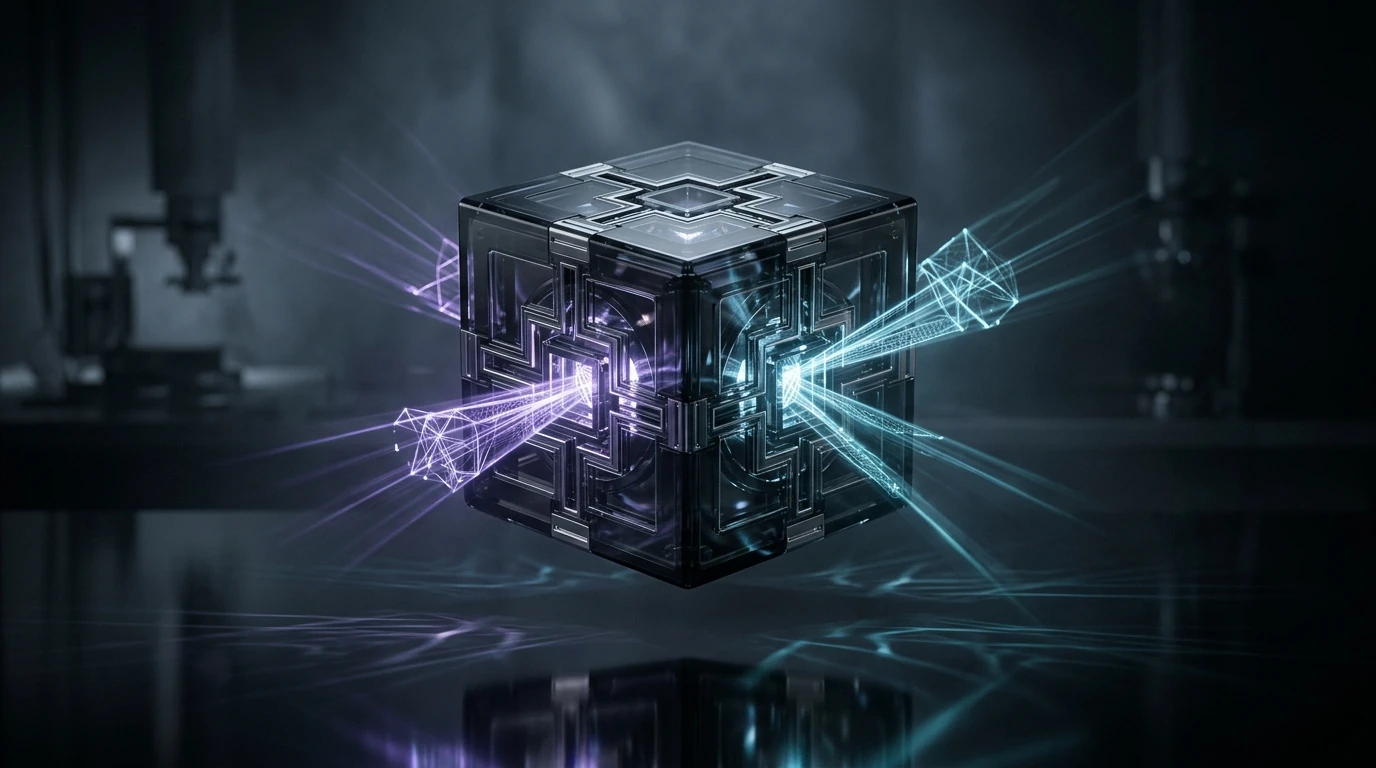
A Zero-Knowledge Proof (ZKP) is a mathematical protocol allowing one party (the prover) to prove to another (the verifier) that a statement is true, without revealing any secret information beyond the validity of the statement itself.
First developed by MIT researchers in 1985, ZKPs have become the holy grail of blockchain technology. They solve the two biggest challenges in Web3: privacy (enabling transactions where balances and identities remain completely confidential) and scalability (allowing Ethereum Layer 2 rollups like zkSync, Starknet, and Scroll to bundle thousands of transactions off-chain and verify them with a single tiny mathematical proof).
The Intuitive Mental Model: How ZKPs Work
To understand Zero-Knowledge Proofs, imagine playing Where is Waldo with a friend.
You spot Waldo on a massive, crowded page. You want to prove to your friend that you know exactly where Waldo is, without revealing his location on the page.
How do you do it? You take a giant piece of opaque cardboard much larger than the book, cut a tiny Waldo-sized hole in the middle, and place it over the page so only Waldo shows through.
Your friend sees Waldo through the cutout and is 100% convinced you found him. Yet, because the giant cardboard hides the surrounding page coordinates, your friend learns zero information about where Waldo actually is on the map.
Zero-Knowledge Proofs achieve this exact feat for digital data: proving that a secret exists and satisfies specific rules, without exposing the secret itself.
The Three Core Mathematical Properties
For any cryptographic proof to qualify as a true Zero-Knowledge Proof, it must satisfy three unbreakable mathematical guarantees:
1. Completeness: If the statement is true and both parties follow the rules, an honest verifier will always accept the proof as valid.
2. Soundness: If the statement is false, it is mathematically impossible for a cheating prover to trick the verifier into accepting it (except with a vanishingly tiny probability like $1 \text{ in } 2^{128}$).
3. Zero-Knowledge: If the statement is true, the verifier learns nothing except the fact that the statement is true. The private witness data remains completely undisclosed.
ZK-SNARKs vs ZK-STARKs: The Ultimate Comparison
In the blockchain ecosystem, two major architectures dominate the Zero-Knowledge landscape: ZK-SNARKs and ZK-STARKs.
| Characteristic | ZK-SNARKs | ZK-STARKs |
|---|---|---|
| Full Name | Succinct Non-Interactive Argument of Knowledge | Scalable Transparent Argument of Knowledge |
| Proof Size | Tiny (~200 to 400 bytes) | Larger (~10 to 100 kilobytes) |
| On-Chain Gas Cost | Extremely low (constant O(1) gas) | Higher verification gas on L1 |
| Trusted Setup | Required for older variants (Groth16) | None required (100% transparent) |
| Quantum Resistance | Vulnerable to future quantum computers | Quantum-resistant (hash-based) |
| Live Implementations | Zcash, Scroll, Linea, Taiko | Starknet, dYdX v3, Immutable X |
SNARKs excel at minimal gas footprints on Ethereum L1, while STARKs provide transparency and long-term quantum security.
How ZK-Rollups Scale Ethereum
While privacy was the original inspiration for ZKPs, their biggest commercial use case today is blockchain scaling.
Ethereum can only process approximately 15 to 30 transactions per second (TPS) on Layer 1. When network demand surges, gas fees skyrocket.
ZK-Rollups (Validity Rollups) solve this bottleneck through transaction compression:
- An off-chain sequencer executes thousands of user transactions on Layer 2 in milliseconds.
- The sequencer compiles the state changes into an arithmetic circuit and generates a single ZK validity proof.
- The validity proof is posted to an Ethereum Layer 1 smart contract.
- Ethereum verifies the mathematical proof in a fraction of a second. Instead of verifying 10,000 separate signatures and balances, Ethereum only checks one proof, slashing user gas fees by 90% to 99%.
Real-World Applications Beyond Crypto
Zero-Knowledge Proofs are transforming security, privacy, and identity across the broader technology world:
- Decentralized Identity (SSI): Prove you are over 21 years old to enter a venue or website without revealing your birthdate, legal name, or home address.
- Credit Scoring & Proof of Reserves: Prove you have a credit score above 750 or an account balance exceeding $100,000 without showing bank statements or account numbers.
- Anti-Cheat in Web3 Gaming: Prove a player made a valid move in fog-of-war strategy games without broadcasting hidden map positions to competitors.
- Machine Learning Integrity (zkML): Prove that an AI model ran a specific prompt without tampering, while keeping proprietary model weights confidential.
Developer Tooling and Circuit Languages
Building with Zero-Knowledge Proofs requires specialized programming languages and proving frameworks:
- Circom & snarkjs: A popular domain-specific language for writing arithmetic circuits used by Ethereum developers.
- Cairo (StarkWare): A Turing-complete programming language specifically optimized for generating STARK proofs on Starknet.
- Noir (Aztec): A modern Rust-like language designed to make private smart contract development intuitive.
- Halo2 & Plonky2: High-performance proving systems that enable recursive proofs and sub-second proof generation times.
Security Risks and Circuit Auditing
ZKPs offer mathematical perfection, but the software code that implements them can still contain vulnerabilities:
- Under-Constrained Circuits: If a developer misses a mathematical constraint in an arithmetic circuit, an attacker can generate a valid proof for an invalid state transition (such as minting infinite tokens).
- Trusted Setup Compromise: In older SNARK ceremonies, if all participants secretly colluded, they could forge fake proofs without detection.
- Complexity & Tooling Bugs: Translating complex business logic into polynomial equations is error-prone. This makes specialized smart contract and circuit audits from top security firms essential before launching on mainnet.
Investor Checklist: Evaluating ZK Protocols
Before investing in or deploying assets onto any ZK-powered protocol or rollup, verify these 8 critical factors:
- ✓ EVM Compatibility (Type-1 to Type-4): Is the rollup bytecode-compatible with standard Ethereum contracts or does it require code rewrites?
- ✓ Data Availability Mode: Does the protocol post full transaction data to Ethereum L1 blobs (EIP-4844) or rely on external DA committees?
- ✓ Prover Decentralization: Can independent third parties generate proofs, or is proof generation restricted to a single centralized server?
- ✓ Escape Hatch / Force Withdrawal: Can users withdraw their funds directly on Ethereum L1 if the L2 sequencer goes offline?
- ✓ Published Circuit Audits: Have all cryptographic circuits been audited by specialized formal verification firms?
- ✓ Proving Time & Gas Costs: Does the protocol offer reasonable transaction finality windows and low user fees?
- ✓ Open-Source Prover Code: Is the prover codebase publicly verified on GitHub for community inspection?
Zero-Knowledge cryptography represents the mathematical frontier of Web3. Understanding its constraints gives you an edge in identifying genuine technological innovation.
Core Cryptographic Pillars
The fundamental mathematical properties that make Zero-Knowledge Proofs the bedrock of Web3 scaling and identity.
Completeness Guarantee
If a statement is genuinely true and both parties follow protocol rules, an honest verifier will always be convinced of the proof with 100% mathematical certainty.
Soundness Guarantee
If a statement is false, no cheating prover can fake a valid proof, ensuring the probability of deceiving the verifier is computationally negligible.
Zero-Knowledge Property
The verifier learns absolutely zero secret data during verification other than the single binary truth that the claimed statement is valid.
Succinct Verification
Verification computation runs in milliseconds regardless of how complex the underlying computation was, compressing gigabytes of data into bytes.
Match the Terms
Connect each Zero-Knowledge concept with its accurate explanation.
Key Concepts
Explore the core cryptography concepts powering Zero-Knowledge Proofs and Layer 2 validity systems.
The Prover (π)
The party that executes the private computation and constructs a cryptographic proof demonstrating that the computation was performed correctly without leaking inputs.
Myth or Fact?
Test your instincts on Zero-Knowledge Proof myths versus realities.
Zero-Knowledge Proofs are the definitive mathematical foundation for Web3 privacy and hyperscale throughput.
By separating transaction execution from validation, ZKPs allow Ethereum to scale infinitely while preserving trustless decentralized security. Mastering ZK fundamentals is essential for navigating the next decade of blockchain infrastructure.